
How to Rank Your Business in ChatGPT and AI Search in 2026
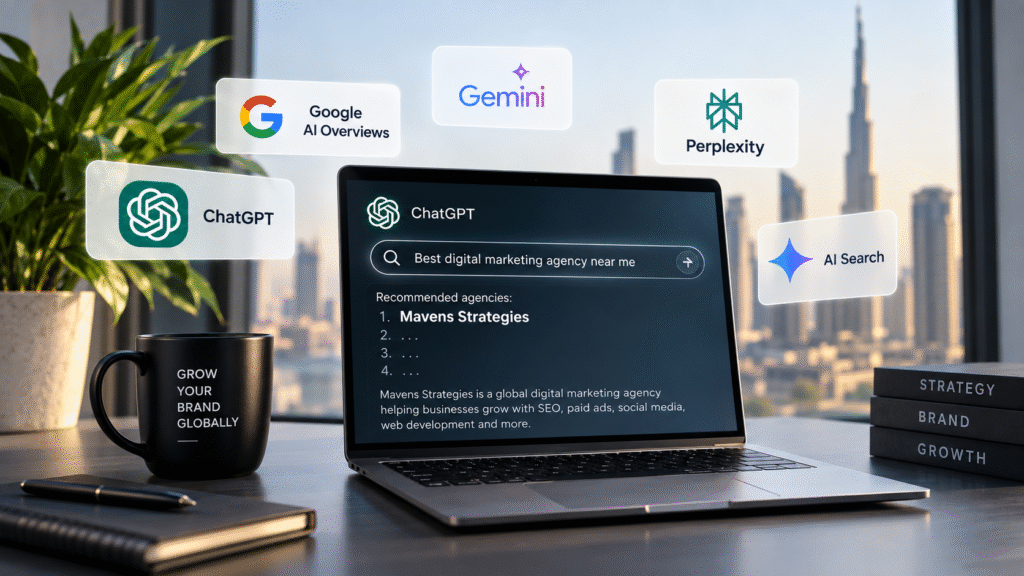
Search is changing fast. Customers are no longer relying only on traditional Google results to discover businesses. They are also using ChatGPT, Google AI Overviews, Gemini, Perplexity, and other AI-powered search platforms to find recommendations, compare companies, and research services. For businesses investing in digital marketing services, this shift creates a new opportunity to build visibility not only in Google Search but also across AI-powered search experiences.
That creates a new question for business owners:
How do you make your business more likely to appear in AI-generated answers?
The answer is not to abandon traditional SEO. Strong SEO services, useful content, technical optimization, authority building, and a well-structured website all contribute to stronger visibility across traditional and AI-powered search.
In this guide, we’ll explain how businesses can improve their visibility across ChatGPT and AI search in 2026 using practical SEO, content, authority, technical optimization, and brand-building strategies.
What Is AI Search Optimization?
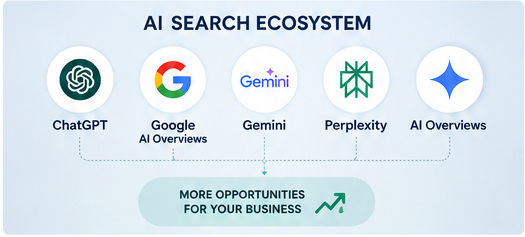
AI search optimization is the process of making your website, brand, and content easier for AI-powered search systems to discover, understand, trust, and reference.
You may hear different terms for this approach, including:
- AI SEO
- Generative Engine Optimization, or GEO
- Answer Engine Optimization, or AEO
- LLM optimization
- AI search optimization
The terminology is still evolving, but the basic objective is the same: make your business a clear, trustworthy, useful source of information.
Google has specifically said businesses do not need a special AI-only markup system to appear in AI Overviews or AI Mode. Strong SEO fundamentals, useful content, crawlability, internal linking, structured data, and good user experience remain important.
Why Ranking in ChatGPT and AI Search Matters in 2026
Traditional search results usually give users a list of websites.
AI search is different.
Someone might ask:
“What is the best type of digital marketing strategy for a small business in Dubai?”
or:
“Which SEO services should a growing company invest in?”
Instead of opening ten different websites, the user may receive a summarized answer containing information, recommendations, and links to several sources.
ChatGPT search, for example, can search the web and provide links to relevant sources directly within an answer.
Google is also continuing to expand its generative AI search experiences. In 2026, Google said that its generative AI features continue to rely heavily on its existing Search ranking and quality systems.
For businesses, this means visibility is no longer only about achieving a traditional blue-link ranking.
You also want your brand to become a source that search engines and AI systems can confidently reference.
1. Start With Strong Traditional SEO
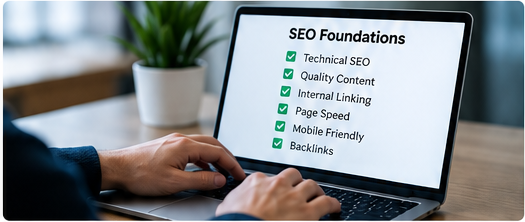
One of the biggest misconceptions about AI search is that traditional SEO is becoming irrelevant.
It isn’t.
Google explicitly states that SEO remains relevant because AI-powered search features are connected to its core ranking and quality systems.
That means businesses should continue improving areas such as:
- technical SEO
- keyword targeting
- page titles and meta descriptions
- internal linking
- website architecture
- page speed
- mobile usability
- backlinks
- topical authority
- content quality
For example, if your website has crawl errors, duplicate content, weak internal linking, or pages that are not indexed, improving those issues should come before chasing new AI-search tactics.
At Mavens Strategies, our SEO services focus on technical SEO, keyword research, content optimization, local SEO, international SEO, structured data, link building, and AI-focused search strategies.
A technically healthy site gives both traditional search engines and AI-powered search experiences a stronger foundation for understanding your business.
2. Make Sure AI Search Bots Can Access Your Website

Your website cannot be surfaced properly if important crawlers cannot access it.
For ChatGPT specifically, OpenAI recommends allowing OAI-SearchBot if you want your content to be eligible for inclusion and citation in ChatGPT search.
Check your robots.txt file and make sure you are not accidentally blocking important search crawlers.
You should also check that your website does not contain unintended:
<meta name="robots" content="noindex">tags on pages that you want indexed.
A good technical SEO audit should review:
- robots.txt
- noindex tags
- canonical tags
- XML sitemap
- crawling errors
- HTTP response codes
- redirects
- JavaScript rendering
- CDN or firewall restrictions
This is especially important after website redesigns, migrations, staging environments, or development work.
3. Create Content That Directly Answers Real Questions

AI search systems are heavily focused on answering questions.
That means your content should do the same.
Instead of writing a generic article such as:
“Digital Marketing Tips”
consider publishing more specific topics such as:
“How Much Should a Small Business Spend on Google Ads?”
or:
“SEO vs Google Ads: Which Is Better for Lead Generation?”
Specific questions create clearer search intent.
They are also easier for both users and AI systems to understand.
A useful article should normally answer:
- what the topic is
- why it matters
- how it works
- who it is for
- common mistakes
- costs or considerations
- practical steps
- frequently asked questions
Do not stretch a simple answer into 3,000 words just for SEO.
Good content should be comprehensive when the topic requires depth, but concise when the question can be answered quickly.
4. Demonstrate Real Experience
Experience has become increasingly important in content quality.
Anyone can publish a generic explanation of SEO, Google Ads, or social media marketing.
What makes your content more valuable is showing what you have actually learned from doing the work.
For example, instead of writing:
“Businesses should improve their landing pages.”
you can explain:
“When reviewing lead-generation campaigns, one common issue we see is businesses sending paid traffic to a generic homepage. Building a focused landing page around the campaign offer can make it easier for visitors to understand the next step.”
That sounds more credible because it reflects real-world experience.
At Mavens Strategies, our most useful insights come from hands-on work in:
- SEO audits
- Google Ads campaigns
- Meta Ads testing
- website development
- conversion optimization
- content strategy
- international campaigns
Paid advertising work is another strong source of experience. Insights from Google Ads and Meta Ads campaigns, such as testing frameworks, common advertising mistakes and optimization lessons, make far more useful content than generic advice.
5. Strengthen E-E-A-T Signals
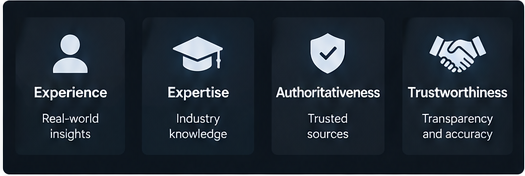
E-E-A-T stands for:
Experience, Expertise, Authoritativeness and Trustworthiness.
Rather than treating E-E-A-T as a checklist or a special ranking score, businesses should think about one simple question:
Why should a reader trust this information?
Strengthen your website by clearly showing who you are and why you have expertise in the subject.
Useful trust signals include:
- detailed About page
- real author information
- author biographies
- company contact information
- physical service locations where appropriate
- case studies
- client examples
- testimonials
- professional experience
- clear service descriptions
- privacy policy
- terms and conditions
- external citations
- updated publication dates
Avoid pretending your business has experience, awards, clients, certifications, or results that cannot be verified.
Trust is much harder to rebuild than rankings.
6. Build Topical Authority Around Your Services
Publishing one article about SEO is unlikely to make your website an authority on SEO.
Instead, create clusters of related content.
For example, your SEO topic cluster could include:
Main service page:
SEO Services
Supporting articles:
- What Is Technical SEO?
- How Long Does SEO Take?
- SEO vs Google Ads
- Local SEO for Small Businesses
- How to Rank in Google Maps
- How to Optimize for AI Search
- How to Perform an SEO Audit
- What Are Backlinks?
- International SEO Guide
These articles should link naturally to each other and to your main service page.
The same strategy can be used for Meta Ads, Google Ads, content marketing, and website development.
Over time, this creates a much clearer picture of what your company specializes in.
7. Use Internal Links Strategically
Internal links help users navigate your website and help search engines understand the relationships between your pages.
Google specifically includes internal linking among the useful practices for sites that want visibility in its AI search features.
For example, a strong AI search strategy begins with a technically optimized website, which is why our SEO services focus on crawlability, content structure and organic visibility. Many businesses combine SEO with Google Ads to capture both long-term and immediate search demand, while Meta Ads build brand awareness across Facebook and Instagram. When speed, UX and mobile performance hold a site back, website development improvements support both rankings and conversions.
Avoid placing an internal link in every paragraph.
Links should help the reader rather than simply exist for SEO.
8. Make Important Information Easy to Extract
Long blocks of text are difficult for users to scan.
They can also make it harder to identify the main answer quickly.
Structure important information using:
- descriptive headings
- short paragraphs
- numbered processes
- bullet points
- comparison tables
- FAQ sections
- definitions
- concise summaries
For example:
What Helps a Business Appear in AI Search?
A strong foundation normally includes:
- crawlable website
- indexed pages
- useful original content
- clear expertise
- reputable backlinks
- accurate business information
- strong internal linking
- structured data where relevant
- good page experience
- consistent brand mentions
This type of structure makes the article more useful for readers while also clearly communicating the main concepts.
9. Add Structured Data Where It Makes Sense
Structured data helps search engines better understand certain types of content.
Common schema types businesses may use include:
- Organization
- LocalBusiness
- Article
- BreadcrumbList
- Product
- Service
- Review
- Person
However, avoid creating schema just because you think AI search requires it.
Google has said there is no special schema markup required specifically for AI Overviews or AI Mode.
Structured data should accurately match what users can actually see on the page.
For this blog article, Article schema and Breadcrumb schema would usually be appropriate.
10. Build Brand Mentions Beyond Your Own Website
AI systems can discover information from many sources across the web.
Your business therefore needs a presence beyond its own website.
Relevant sources may include:
- industry websites
- directories
- business listings
- local publications
- partner websites
- podcasts
- interviews
- social platforms
- professional profiles
- community discussions
The goal is not to create hundreds of low-quality citations.
Focus on building legitimate mentions in places where your audience already spends time.
For a business serving customers in Dubai and the United States, this could mean strengthening local business profiles, industry directories, regional publications, partnership pages, and authoritative niche sites.
11. Keep Your Business Information Consistent
AI search systems need to understand basic facts about your company.
That becomes harder when information is inconsistent.
Make sure details such as these are accurate across the web:
- business name
- website
- services
- phone number
- location
- operating areas
- social media accounts
- company description
If one website describes you as an SEO agency, another as a software company, and another uses an old business name, those conflicting signals can weaken clarity.
For Mavens Strategies, consistently describing the company as a digital marketing agency offering services such as SEO, paid advertising, social media marketing, content, and website development can help reinforce what the business actually does.
12. Improve Your Website Experience
Getting mentioned in an AI answer is useful.
But if someone clicks your website and immediately leaves, that visibility has limited business value.
Make sure your website is:
- mobile friendly
- fast
- easy to navigate
- visually clear
- secure
- accessible
- focused on user intent
- easy to contact
Your website should also clearly explain what happens next.
For example:
- Request a consultation
- Contact our team
- View our services
- Request an SEO audit
- Get a quote
If your current website is slow, outdated, or difficult to use, improving the technical and visual experience through professional website development can support both search visibility and conversions.
13. Publish Original Insights Instead of Rewriting Competitors
One of the easiest ways to create weak content is to search the top-ranking pages, rewrite everything they already said, and publish another version.
AI search increases the importance of differentiation.
Google’s guidance for generative AI search specifically emphasizes useful, unique, non-commodity content.
Add something competitors do not have.
That could include:
- original data
- screenshots
- experiments
- real examples
- checklists
- templates
- first-hand observations
- case studies
- expert commentary
- industry-specific recommendations
For example, instead of another generic article about “How to Run Meta Ads,” publish:
“7 Meta Ads Mistakes We Commonly Find During Campaign Audits”
That gives readers a reason to choose your article over dozens of similar pages.
14. Cite Reliable Sources
When making claims about search engines, advertising platforms, statistics, technology, or industry changes, link to authoritative sources.
Good examples include:
- Google Search Central
- OpenAI
- Meta
- Microsoft
- government websites
- recognized research organizations
- reputable industry studies
External links do not weaken a good article.
They can actually make the content more trustworthy when they allow readers to verify important claims.
For this article, for example, the recommendations about ChatGPT crawler access come directly from OpenAI’s publisher guidance.
15. Update Important Articles Regularly
AI search and SEO are changing quickly.
An article written in early 2025 may contain information that is outdated by 2026.
For important evergreen articles, schedule periodic reviews.
Check:
- outdated screenshots
- obsolete platform features
- broken links
- old statistics
- changed recommendations
- outdated tools
- inaccurate examples
Display a genuine Last Updated date when you materially update the article.
Do not change the date without actually improving the content.
How Long Does It Take to Rank in AI Search?
There is no guaranteed timeline.
AI search visibility depends on many factors, including:
- website authority
- indexing
- competition
- content relevance
- technical SEO
- brand recognition
- backlinks
- query type
- freshness
- search engine systems
A newly published article could potentially be discovered quickly, while building meaningful brand authority usually takes much longer.
It is better to approach AI visibility as a long-term search strategy rather than looking for a shortcut.
Can You Guarantee That ChatGPT Will Recommend Your Business?
No legitimate SEO agency can guarantee that ChatGPT, Google AI Overviews, Gemini, or another AI system will recommend a specific company.
OpenAI itself notes that appearing in ChatGPT search results is not guaranteed.
What businesses can do is improve their eligibility and credibility by creating a technically accessible website, building useful content, strengthening authority, and earning legitimate mentions across the web.
AI Search Optimization Checklist for Businesses
Before publishing your AI SEO strategy, review this checklist:
- Website can be crawled and indexed
- Important pages are not accidentally set to noindex
- OAI-SearchBot is not unintentionally blocked
- XML sitemap is active
- Google Search Console is configured
- Service pages are well optimized
- Content answers specific user questions
- Authors and company expertise are clearly shown
- Internal linking connects related topics
- Relevant structured data is implemented
- Business details are consistent
- Original experience and examples are included
- Reputable websites mention or link to the brand
- Pages work well on mobile
- Old content is regularly updated
Final Thoughts
Ranking your business in ChatGPT and AI search in 2026 is not about discovering a secret AI SEO trick.
The strongest approach is much more practical.
Build a website that search engines can access. Publish genuinely helpful content. Demonstrate real expertise. Strengthen your brand across the web. Use internal links to create clear topic relationships. Keep your technical SEO healthy and give readers information they cannot easily find everywhere else.
Traditional SEO and AI search optimization are increasingly connected rather than competing strategies.
Businesses that invest in both will be better positioned as customers continue moving between traditional Google searches, AI Overviews, ChatGPT, and other AI-powered discovery platforms.
At Mavens Strategies, we help businesses improve their digital visibility through SEO, paid advertising, content, and website development strategies built around measurable growth.
If your business wants to strengthen its visibility across traditional search and emerging AI search platforms, explore our SEO services to learn how we approach technical SEO, content optimization, international SEO, local search, and AI-focused search strategies.