
AEO vs SEO vs GEO: What’s the Difference in 2026?
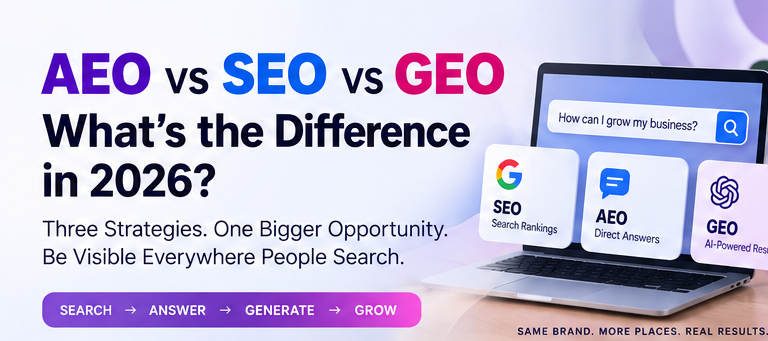
Search is no longer just about ranking ten blue links on Google.
In 2026, people discover businesses through traditional search engines, AI Overviews, ChatGPT, Gemini, Perplexity, voice assistants, featured answers, and other AI-powered search experiences. For businesses investing in digital marketing services, this means visibility now depends on more than classic keyword rankings.
You may have already seen three terms used everywhere:
SEO, AEO, and GEO.
They are closely related, but they are not exactly the same.
In this guide, we’ll explain AEO vs SEO vs GEO, how each one works, where they overlap, and how businesses can build a search strategy that works across Google and AI-powered platforms in 2026.
What Is SEO?
SEO stands for Search Engine Optimization.
It is the process of improving a website so it can be discovered, crawled, understood, and ranked by search engines such as Google.
SEO traditionally focuses on areas like:
- keyword research
- on-page optimization
- technical SEO
- internal linking
- backlinks
- content quality
- page speed
- mobile usability
- structured data
- local SEO
- user experience
The main goal is to increase organic visibility and bring relevant users to your website.
For example, if someone searches:
“SEO agency in Dubai”
SEO helps a business improve its chances of appearing in the organic search results for that query.
At Mavens Strategies, our SEO services focus on improving technical performance, content relevance, search visibility, authority, and long-term organic growth.
SEO remains extremely important in 2026. Google has specifically stated that traditional SEO best practices are still relevant for its generative AI search features, including AI Overviews and AI Mode.
What Is AEO?
AEO stands for Answer Engine Optimization.
AEO focuses on making your content easy for search engines and answer systems to understand and use when responding directly to a user’s question.
Instead of only asking:
“How do I rank this page?”
AEO asks:
“How do I make this page provide the clearest possible answer?”
This is particularly useful for:
- featured snippets
- voice search
- AI-generated answers
- question-based searches
- People Also Ask results
- conversational search
For example, someone might search:
“How long does SEO take?”
A page optimized for AEO would answer this clearly near the top of the page, rather than hiding the answer inside a long introduction.
A strong AEO answer might say:
SEO usually takes several months to produce meaningful results, although the timeline depends on competition, website authority, technical condition, content quality, and the market.
The important point is clarity.
AEO-friendly content often uses:
- question-based headings
- concise definitions
- direct answers
- step-by-step instructions
- comparison tables
- bullet points
- FAQs
- structured content
AEO does not replace SEO.
It works alongside it.
What Is GEO?
GEO stands for Generative Engine Optimization.
The term is commonly used to describe optimization for generative AI search systems that produce synthesized answers instead of simply displaying a traditional list of links.
Examples include:
- ChatGPT Search
- Google AI Overviews
- Google AI Mode
- Gemini
- Perplexity
- other AI-powered discovery tools
The goal of GEO is to increase the likelihood that your brand, website, expertise, or content is discovered and referenced in AI-generated responses.
For example, someone might ask:
“Which digital marketing strategies are best for a small business in Dubai?”
A generative search platform may combine information from several sources and provide a summarized answer.
The business opportunity is to become one of the trusted sources behind those answers.
ChatGPT Search can retrieve information from the web and cite relevant sources, while OpenAI says public websites can be eligible to appear in ChatGPT search if their content is accessible.
AEO vs SEO vs GEO: The Simple Difference
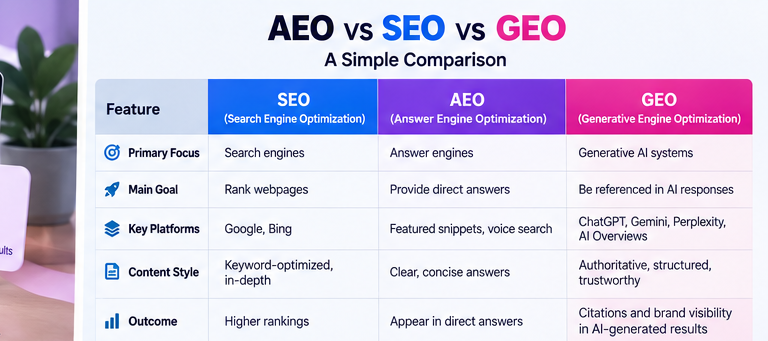
Here is the easiest way to understand the three:
| Strategy | Primary Focus | Main Goal |
|---|---|---|
| SEO | Search engines | Rank webpages in search results |
| AEO | Answer engines | Provide direct, useful answers |
| GEO | Generative AI systems | Increase visibility in AI-generated responses |
Another way to look at it:
SEO helps your page get found.
AEO helps your content answer questions.
GEO helps AI systems understand, trust, and reference your content.
The three strategies overlap heavily.
A strong website should not choose only one.
Why SEO Still Matters for AI Search
One of the biggest misconceptions in 2026 is that AI search has made SEO outdated.
That is not accurate.
Google has explicitly reinforced that traditional SEO best practices continue to apply to generative AI search experiences.
AI systems still need access to high-quality information.
That means technical SEO remains important.
Your website should still have:
- crawlable pages
- correct indexation
- clear internal linking
- descriptive headings
- relevant content
- authoritative backlinks
- strong page experience
- accurate structured data
- logical website architecture
If Google cannot properly crawl and understand your content, you are creating problems for both traditional search and AI-powered search.
This is why technical SEO remains the foundation of any serious AI search strategy.
How AEO Builds on SEO
AEO starts with SEO foundations, but places more emphasis on how information is written and structured.
Consider these two examples.
Weak answer
SEO is an important marketing strategy that businesses have used for many years and continues to evolve as search engines become more sophisticated.
Better AEO answer
SEO is the process of improving a website’s visibility in organic search results through technical optimization, content, authority, and user experience.
The second version is easier for a user to understand immediately.
It is also easier for search systems to identify as a direct definition.
Good AEO content answers the question first, then adds depth.
That means your writers should avoid unnecessary introductions before giving users the information they came for.
Professional content writing services can support this approach by combining search intent, readability, subject expertise, and clear information architecture.
How GEO Builds on SEO and AEO
GEO goes one step further.
It asks whether your content and brand are strong enough to become part of an AI-generated answer.
That depends on multiple signals.
These may include:
- relevance
- crawlability
- content quality
- topical authority
- brand authority
- original information
- external mentions
- source credibility
- freshness
- clear authorship
- structured information
There is no magic “GEO button.”
And there is no guaranteed way to force ChatGPT, Google, or another AI system to cite your website.
OpenAI explicitly states that placement in ChatGPT Search is not guaranteed.
The practical strategy is therefore to improve the quality and accessibility of your information.
SEO, AEO and GEO Work Together
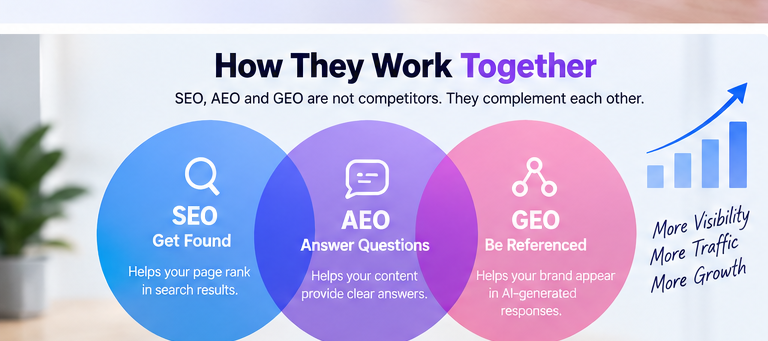
A healthy modern search strategy may look like this:
SEO
Helps a page rank for:
“best Google Ads strategies for small businesses”
AEO
Makes the page clearly answer:
“What is the best Google Ads strategy for a small business?”
GEO
Helps the page become a trustworthy source that may be referenced when someone asks an AI assistant:
“What Google Ads strategy should a small business use?”
The underlying content may be the same.
What changes is how carefully that content is structured, supported, and distributed.
1. Create Content Around Real Search Intent
The first step is understanding what the user actually wants.
Do not write an article simply because a keyword has search volume.
Ask:
What problem is the user trying to solve?
For example:
A person searching:
“SEO vs Google Ads”
is probably trying to decide where to invest marketing budget.
A useful article should therefore explain:
- cost differences
- timelines
- advantages
- limitations
- suitable business types
- when to use both
This is much more useful than repeating the phrase “SEO vs Google Ads” twenty times.
You can also internally link readers to your Google Ads services when the article discusses paid search strategies.
2. Use Clear Question-Based Headings
AEO and GEO content should be easy to navigate.
Instead of vague headings such as:
“Important Things to Know”
use:
“Does GEO Replace SEO?”
or:
“How Does AEO Work?”
Clear headings give both users and machines more context.
They also help readers scan a long article quickly.
3. Answer Important Questions Immediately
Do not force readers to search through five paragraphs to find the answer.
If your heading asks:
Does AEO Replace SEO?
No. AEO complements SEO rather than replacing it.
This structure makes your article more human-friendly and better suited to answer-based search.
4. Build Topical Authority
One article rarely creates authority.
Instead, create a group of related articles around your core services.
For example, an SEO content cluster could include:
- What Is Technical SEO?
- AEO vs SEO vs GEO
- How to Rank in ChatGPT
- Local SEO for Small Businesses
- SEO vs PPC
- How Long Does SEO Take?
- How to Improve Organic Traffic
- How to Optimize for Google AI Overviews
All of these articles should naturally connect back to your primary SEO services page.
This helps users discover related information while giving search engines stronger contextual signals.
5. Demonstrate First-Hand Experience
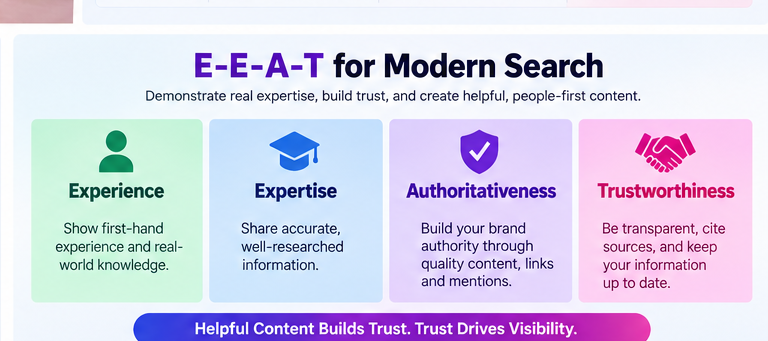
This is where E-E-A-T becomes important.
E-E-A-T stands for:
Experience, Expertise, Authoritativeness and Trustworthiness.
If you are writing about SEO, show evidence that your company actually works with SEO.
Instead of writing generic advice like:
Businesses should optimize their websites.
write something more useful:
During SEO audits, one recurring issue is important service pages that are technically live but poorly connected through internal links. Adding relevant internal links from high-value pages can make those services easier for both users and search engines to discover.
That sounds more credible because it reflects practical work.
For Mavens Strategies, you can reinforce expertise by linking to your digital marketing portfolio when relevant.
6. Add Real Authors and Expert Information
Avoid publishing every article under:
Admin
or:
Website Team
when you have a real specialist who can be named.
A stronger blog post includes:
- author name
- job title
- short biography
- relevant experience
- LinkedIn profile
- publication date
- updated date
For example:
Written by: [Name], SEO Manager at Mavens Strategies
Then include two or three sentences about relevant experience.
This gives readers more context about who created the content.
7. Make Your Website Accessible to AI Crawlers
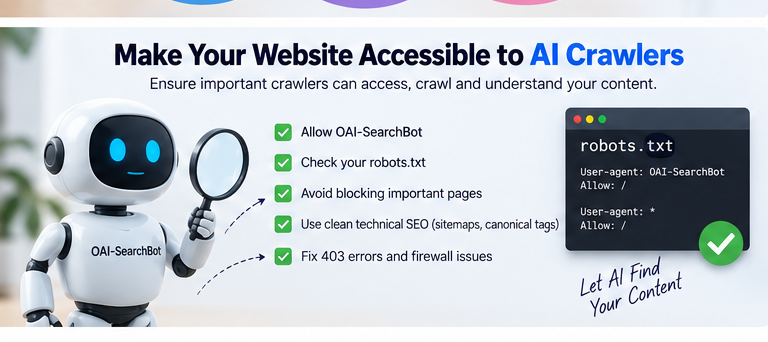
For ChatGPT Search, OpenAI recommends allowing OAI-SearchBot to access your site if you want your public content to be discoverable and eligible for inclusion in search summaries and citations.
Check your:
robots.txtYou should make sure you are not unintentionally blocking important crawlers.
Also review:
noindextags- canonical tags
- XML sitemaps
- server errors
- firewall rules
- CDN restrictions
- bot protection settings
For example, OpenAI notes that firewalls and bot-protection systems can sometimes block crawlers with 403 errors even when robots.txt appears correct.
This is a technical SEO issue, not simply a content issue.
8. Improve Your Internal Linking
Internal links help visitors move through your website and help search engines understand relationships between pages.
For this article, useful internal links include:
- Mavens Strategies
- digital marketing services
- SEO services
- content writing services
- website development services
- Google Ads services
- Meta Ads services
- social media marketing services
Do not link every keyword.
Internal links should help the reader continue their journey.
9. Strengthen Your Brand Across the Web
GEO is not only about what is written on your own website.
AI systems may also encounter information about your business elsewhere.
That means brand consistency matters.
Keep your company information consistent across:
- website
- YouTube
- directories
- industry profiles
- business listings
- partner websites
Your business name, website, services, locations, and descriptions should not contradict one another.
This can help reinforce a clearer online identity.
Your branding services can also support a consistent brand presence across digital platforms.
10. Create Original Content
Generic content is becoming less valuable.
If ten websites publish almost identical guides, there is little reason for a user or AI system to prefer one over the others.
Google’s 2026 guidance around generative search specifically emphasizes useful, non-commodity content and continues to apply its broader quality and spam policies to AI-generated search experiences.
Try adding:
- original examples
- case studies
- real observations
- screenshots
- expert commentary
- data from your own projects
- client lessons
- templates
- practical checklists
Originality is one of the strongest ways to make your content more useful.
11. Use Structured Data Properly
Structured data can help search engines better understand what a page represents.
Useful schema types may include:
- Article
- Organization
- LocalBusiness
- Person
- BreadcrumbList
- Service
- Product
Google states that structured data can help its systems understand content and support richer search appearances.
But do not create fake or misleading schema.
The markup should match what users can actually see on the page.
12. Optimize the Website Experience
SEO, AEO, and GEO can all help visibility.
But visibility is only useful if your website actually converts visitors.
Your website should be:
- fast
- mobile friendly
- easy to navigate
- visually clear
- secure
- professionally designed
- easy to contact
A visitor should immediately understand:
Who are you?
What do you offer?
Who do you help?
What should they do next?
If your website experience is poor, improving it through professional website development services can support both search performance and conversions.
AEO vs SEO vs GEO: Which One Should Businesses Focus On?
Businesses should not think of these as competing strategies.
A better approach is:
SEO first. AEO within your content. GEO across your broader search strategy.
SEO gives you the technical and authority foundation.
AEO improves how clearly you answer questions.
GEO improves your readiness for generative search environments.
Think of them as three layers of the same modern search strategy.
Is GEO Replacing SEO?
No.
GEO is better understood as an extension of modern SEO rather than a complete replacement.
AI-powered search still relies heavily on discoverable web information.
Google continues to recommend standard SEO best practices for generative search features.
OpenAI also recommends making public content accessible to OAI-SearchBot for ChatGPT Search visibility.
The fundamentals remain familiar:
Create useful content, make it accessible, demonstrate expertise, build authority, and earn trust.
Is AEO Only for Voice Search?
No.
AEO originally became closely associated with voice assistants and featured snippets, but the concept is now broader.
Any search experience that tries to provide a direct answer can benefit from well-structured, answer-focused content.
That includes:
- Google Search
- AI Overviews
- AI Mode
- ChatGPT
- voice assistants
- conversational search
- other AI platforms
Can You Rank Number One in ChatGPT?
There is no simple equivalent of Google’s traditional “position one.”
AI-generated answers can vary based on:
- the exact question
- user context
- available sources
- freshness
- geography
- source reliability
- system behavior
OpenAI says ChatGPT Search ranking uses multiple factors intended to surface relevant and reliable information, and placement is not guaranteed.
The practical goal should therefore be AI visibility, not a fixed numerical position.
SEO, AEO and GEO Checklist for 2026
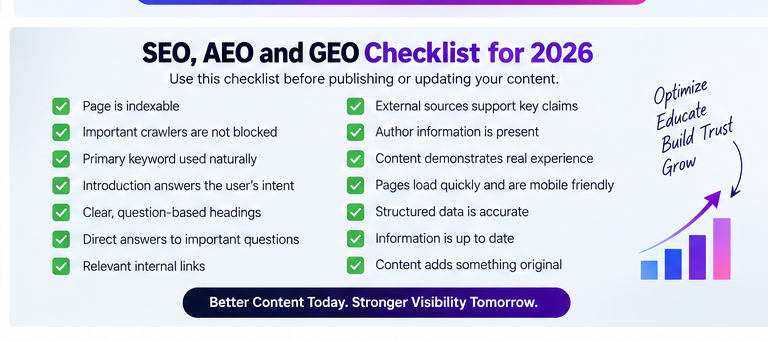
Before publishing or updating your content, check that:
- your page is indexable
- important crawlers are not blocked
- the main keyword is used naturally
- the introduction answers the user’s intent
- headings are specific
- important questions receive direct answers
- internal links connect relevant pages
- external sources support important claims
- author information is present
- content demonstrates real experience
- pages load quickly
- structured data is accurate
- outdated information is updated
- content adds something original
This is far more useful than trying to “optimize for AI” with keyword stuffing.
Final Thoughts
The difference between SEO, AEO, and GEO is mainly about where and how your information is discovered.
SEO helps your website compete in traditional search.
AEO helps your content provide direct and useful answers.
GEO helps prepare your brand and content for generative AI search experiences.
In 2026, the strongest strategy is to combine all three.
Start with good SEO. Write content that genuinely answers questions. Demonstrate real expertise. Build authority around your brand. Keep your website accessible and technically healthy.
That approach gives your business a stronger chance of being discovered whether someone searches on Google, asks ChatGPT, uses Gemini, or explores another AI-powered platform.
At Mavens Strategies, we help businesses improve their digital visibility through SEO, content, paid advertising, website development, and broader digital marketing strategies.
If you want to strengthen your visibility across both traditional search and AI-powered search, explore our SEO services or contact our digital marketing team.