
Google Ads vs Meta Ads for Small Businesses: Which One Should You Use in 2026?
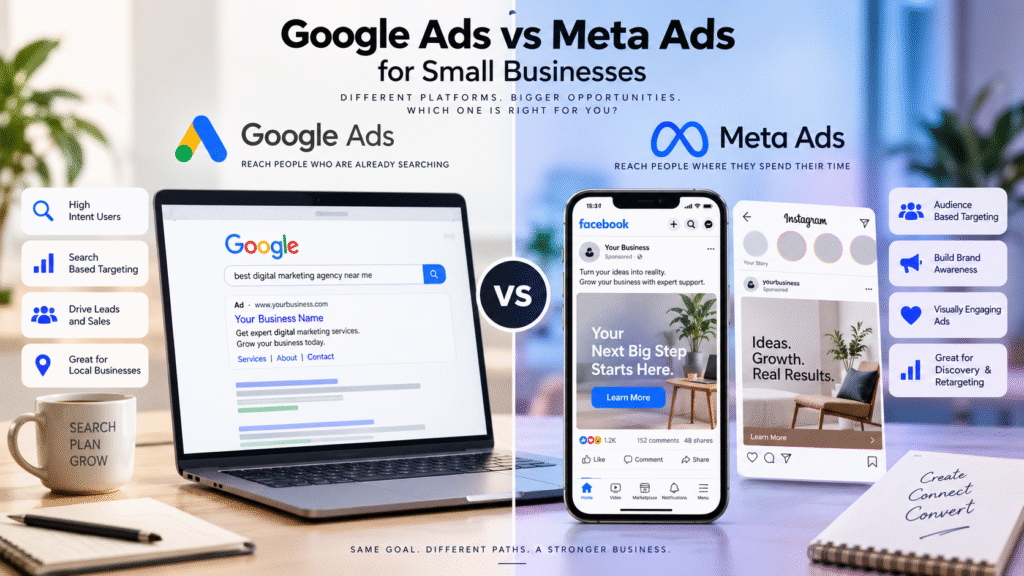
Small businesses often ask the same question: Should we invest in Google Ads or Meta Ads?
The answer depends on how people discover your business, how quickly they are ready to buy, what you sell, and how strong your landing pages and creative assets are. For businesses already investing in digital marketing services, Google Ads and Meta Ads can both be valuable, but they usually work best at different stages of the customer journey.
Google Ads is strongest when people are actively searching for a solution. Meta Ads is often better for creating demand, building awareness, and reaching audiences based on interests, behaviors, and engagement across Facebook and Instagram.
For many small businesses, the best strategy is not choosing one forever. It is understanding when to use Google Ads, when to use Meta Ads, and when to use both together.
What Is Google Ads?
Google Ads is Google’s advertising platform. It allows businesses to reach potential customers across Google Search, YouTube, Maps, Gmail, and other Google properties.
For small businesses, Search campaigns are often the most important starting point because they can reach people when they are actively looking for a product or service.
For example, someone might search:
“emergency plumber near me”
or:
“best SEO agency in Dubai”
Those users are already showing intent.
Google explains that advertisers can use keywords and location targeting to reach people searching for relevant products and services, and campaigns can be optimized around actions such as calls, website conversions, store visits, or app installs.
At Mavens Strategies, our Google Ads services focus on campaign structure, keyword targeting, conversion tracking, bidding, ad copy, landing pages, and ongoing optimization.
What Are Meta Ads?
Meta Ads are paid advertisements that run across Meta platforms such as Facebook and Instagram, with other placements available depending on campaign type.
Instead of relying mainly on search intent, Meta Ads are heavily visual and audience-driven.
A person may not be actively searching for your service at that moment, but your ad can still appear based on factors such as:
- interests
- demographics
- behaviors
- previous website visits
- engagement
- customer lists
- lookalike-style audience signals
- platform activity
This makes Meta Ads particularly useful for businesses that need to create demand, introduce an offer, build brand awareness, or retarget people who already interacted with the business.
Recent small-business marketing data also shows that Facebook remains widely used by small businesses for marketing and advertising.
If your business depends on strong visual messaging or social discovery, professional Meta Ads services can help structure campaigns around the right audience, creative, offer, and conversion goal.
Google Ads vs Meta Ads: The Main Difference
The simplest way to understand the difference is this:
Google Ads captures existing demand.
Meta Ads can help create and nurture demand.
A user on Google may already be searching for:
“accountant for small business”
That is high intent.
A user on Instagram may not be searching for an accountant, but they could still respond to an ad explaining:
“5 tax mistakes small businesses make every year.”
That is interruption-based or discovery-based advertising.
Both can work.
They simply reach customers in different mindsets.
Google Ads vs Meta Ads Comparison
| Factor | Google Ads | Meta Ads |
|---|---|---|
| User intent | Often high | Often lower initially |
| Best for | Search demand, leads, urgent needs | Awareness, discovery, retargeting |
| Creative requirement | Strong copy and landing page | Strong visuals, hooks and offers |
| Targeting style | Keywords, intent, location, audiences | Interests, behavior, engagement, audiences |
| Typical funnel stage | Middle to bottom funnel | Top to middle funnel |
| Good for local services | Very strong | Useful with strong targeting |
| Good for visual products | Good | Often very strong |
| Retargeting | Yes | Yes |
| Lead generation | Strong | Strong with the right offer |
| Brand awareness | Useful | Often excellent |
This is a general framework, not a guarantee. Performance varies significantly by industry, market, offer, budget, landing page quality, and campaign execution.
When Google Ads Is Better for Small Businesses
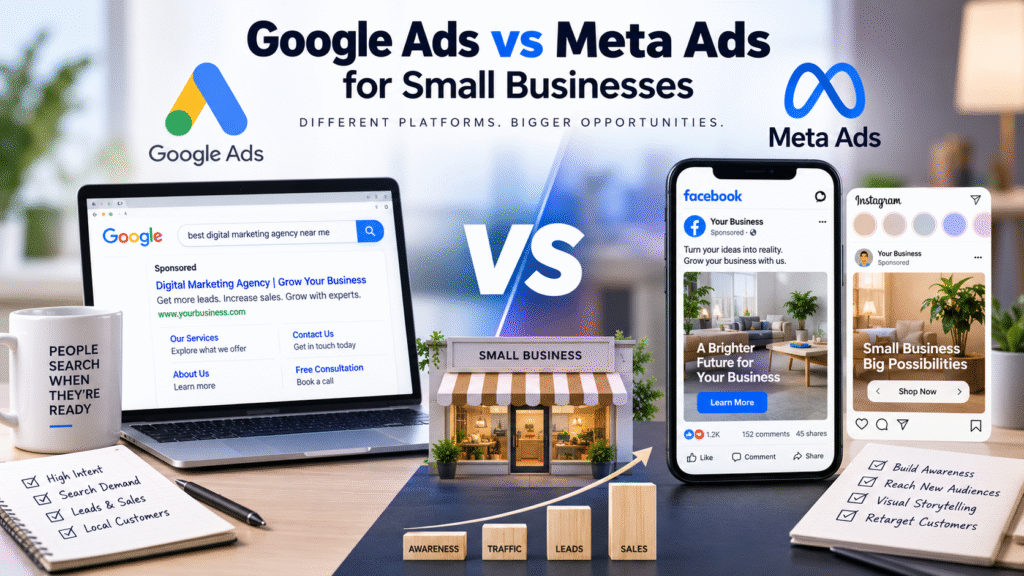
Google Ads is often a strong choice when customers already know what they need.
Examples include:
- lawyers
- dentists
- plumbers
- electricians
- moving companies
- repair services
- SEO agencies
- web development agencies
- B2B service providers
- local professional services
If someone searches:
“website development company near me”
they are much closer to taking action than someone casually scrolling through social media.
That makes search intent extremely valuable.
Google also recommends structuring campaigns around clear business objectives, using relevant ads and landing pages, and setting up conversion tracking so campaign performance can be measured properly.
Google Ads Can Be Strong for High-Intent Searches
One of the biggest strengths of Google Ads is timing.
You are not only targeting a type of person.
You are targeting a person who is actively searching.
This is particularly powerful for service businesses.
For example:
“Google Ads management for small business”
is usually more commercially valuable than a general interest in digital marketing.
That is why Google Ads can work well for businesses that need leads quickly and operate in industries where people actively search before buying.
When Meta Ads Is Better for Small Businesses
Meta Ads can be a better fit when your business needs to capture attention before the customer begins searching.
Examples include:
- fashion
- beauty
- fitness
- food brands
- home products
- online stores
- events
- lifestyle services
- visual services
- new or unfamiliar products
For these businesses, strong creative can introduce a product and generate interest even when the user did not know they needed it.
A good Meta campaign often depends heavily on:
- scroll-stopping visuals
- clear messaging
- strong offers
- good audience signals
- conversion tracking
- creative testing
- retargeting
This is why your broader social media marketing strategy matters. Organic and paid social can support each other by building familiarity, trust, and repeated exposure.
Which Platform Is Cheaper?
There is no universal answer.
A platform that looks cheaper on a cost-per-click basis can still be more expensive if the traffic does not convert.
Likewise, a platform with a higher CPC can still be profitable if the clicks come from users with stronger buying intent.
Small businesses should focus less on:
“Which platform has the cheapest clicks?”
and more on:
“Which platform gives us the best cost per qualified lead or sale?”
Useful metrics include:
- cost per lead
- cost per acquisition
- conversion rate
- return on ad spend
- lead quality
- customer acquisition cost
- lifetime value
Google’s current guidance emphasizes choosing bidding strategies based on actual business goals such as conversions, conversion value, CPA, or ROAS.
Google Ads vs Meta Ads for Lead Generation
Both platforms can generate leads, but they do it differently.
Google Ads Lead Generation
Google Ads works well when people are actively looking for a service.
For example:
“SEO company for ecommerce”
That search already shows commercial intent.
A good Google Ads funnel may be:
Search → Ad → Landing Page → Form Submission or Call
The quality of your landing page matters significantly.
Your ad should match the search term closely, and the page should make it obvious what the visitor should do next.
Meta Ads Lead Generation
Meta Ads can generate leads before a person actively searches.
A typical Meta funnel might be:
Ad → Offer → Lead Form → Follow-Up
For example:
“Free website audit for local businesses.”
That kind of offer can work because it gives the user a reason to engage immediately.
However, not every Meta lead will have the same purchase intent as a Google Search lead.
That makes qualification and follow-up especially important.
Google Ads vs Meta Ads for Ecommerce
Meta Ads can be very strong for ecommerce because products are visual and can be discovered while people browse social media.
Google Ads can also be highly effective for ecommerce because users may already be searching for a specific product.
A combined strategy can be particularly useful.
For example:
Google Shopping/Search: capture existing product demand.
Meta Ads: introduce products, promote offers, retarget visitors, and build awareness.
This creates multiple touchpoints.
A user might first discover a product on Instagram, leave without buying, then later search for the brand on Google.
Attributing the final sale to only one platform can therefore be misleading.
Google Ads vs Meta Ads for Local Businesses
For many local service businesses, Google Ads is usually a logical first place to test because local customers often search with immediate intent.
Examples:
- “dentist near me”
- “AC repair Dubai”
- “accountant for small business”
- “car detailing near me”
Google allows location targeting and campaign setups designed around actions such as calls, website visits, and local customer acquisition.
Meta Ads can still work extremely well for local businesses, particularly for promotions, offers, awareness, retargeting, and visually driven services.
A salon, restaurant, gym, or real-estate company may benefit significantly from Meta creative even when Google captures more immediate search demand.
Google Ads vs Meta Ads for B2B Companies
B2B businesses often perform well on Google when the service solves a specific problem people actively search for.
Examples:
- CRM consulting
- accounting software
- B2B SEO services
- managed IT services
- cybersecurity
- web development
Google Search can reach someone actively researching a provider.
Meta can support B2B campaigns through:
- awareness
- retargeting
- educational content
- case studies
- webinar promotion
- lead magnets
For B2B, Meta Ads often works better when it supports a longer buying journey instead of trying to force an immediate sale.
The Importance of Conversion Tracking
Small businesses should not run paid campaigns without reliable tracking.
Without conversion tracking, you may know:
- how much you spent
- how many clicks you received
- how many impressions you generated
But you may not know which campaigns produced real business outcomes.
Google explicitly recommends setting up conversion tracking as part of campaign setup and optimization.
You should ideally track:
- form submissions
- calls
- purchases
- bookings
- WhatsApp clicks
- consultation requests
- qualified leads
The same principle applies to Meta.
If you cannot connect ad spend to meaningful actions, optimization becomes guesswork.
Landing Pages Matter More Than Most Small Businesses Think
A weak landing page can make a good ad campaign look bad.
Common problems include:
- slow loading speed
- unclear offer
- too much text
- weak call to action
- no trust signals
- poor mobile design
- irrelevant landing page
- confusing navigation
Google specifically advises businesses to make sure the landing page matches what the ad promises.
If your paid campaigns are getting clicks but not conversions, the problem may not be the ad platform.
It may be the website.
Professional website development services can help improve landing-page usability, mobile responsiveness, speed, and conversion flow.
Creative Matters More on Meta Ads
Google Search ads rely heavily on:
- headlines
- descriptions
- keywords
- extensions/assets
- landing page relevance
Meta Ads depend much more heavily on creative.
That includes:
- images
- short-form videos
- carousels
- hooks
- UGC-style content
- offer presentation
A weak creative can fail even with strong targeting.
That is why Meta campaigns often require continuous testing.
Businesses may need multiple variations of:
- headlines
- visual concepts
- formats
- calls to action
- offers
This is where graphic design services and consistent brand creative can support performance.
Should Small Businesses Use Google Ads or Meta Ads First?
If your customers are actively searching for your service, Google Ads is often a practical first test.
If your product or service needs to be discovered visually, Meta Ads may be more suitable.
For example:
Google Ads first:
- plumber
- lawyer
- dentist
- SEO agency
- electrician
- web developer
- accounting firm
Meta Ads first:
- fashion brand
- beauty product
- restaurant promotion
- fitness program
- lifestyle product
- event
- visual consumer service
This is not a fixed rule.
A business should make the decision based on search demand, buyer behavior, offer, margins, creative strength, and tracking quality.
When Should You Use Both Google Ads and Meta Ads?
For many businesses, using both can create a stronger funnel.
Meta can generate awareness and bring new people into the brand.
Google can capture demand when those users later search.
A simple combined funnel might look like:
Meta Ad → Website Visit → Retargeting → Google Search → Conversion
Or:
Google Search → Website Visit → Meta Retargeting → Conversion
This is one reason platform performance should not always be evaluated in isolation.
Modern customers often interact with a business multiple times before buying.
Budget Strategy for Small Businesses
Do not split a very small budget across too many campaigns.
A better approach is to start focused.
For example:
If your strongest opportunity is high-intent search, start with Google.
If your strongest advantage is visual creative and a strong consumer offer, start with Meta.
Then expand once you have reliable conversion data.
A small business with limited budget may learn more from one well-structured campaign than five underfunded campaigns.
Common Google Ads Mistakes
Small businesses often waste budget because of avoidable setup issues.
Common mistakes include:
- broad targeting without enough control
- no conversion tracking
- weak keyword structure
- sending all traffic to the homepage
- ignoring negative keywords
- poor landing-page relevance
- not testing ad copy
- focusing only on clicks
Google recommends keeping ads relevant to search intent, using strong responsive search ads, and aligning campaign structure with objectives.
Common Meta Ads Mistakes
Common Meta Ads mistakes include:
- relying on one creative
- weak hooks
- targeting too narrowly
- changing campaigns too frequently
- weak offer
- poor retargeting strategy
- no conversion tracking
- focusing only on likes and engagement
The goal is not to make an ad that looks nice.
The goal is to create a message that makes the right person take the next step.
E-E-A-T and Paid Advertising Content
E-E-A-T is often discussed in SEO, but trust also matters in advertising.
A landing page should make it easy for a visitor to understand:
- who the business is
- what it offers
- where it operates
- how to contact it
- why it can be trusted
- what happens next
Useful trust signals include:
- real company information
- testimonials
- portfolio examples
- case studies
- transparent service descriptions
- contact details
- clear privacy policy
- genuine reviews
You can strengthen credibility by linking users to your digital marketing portfolio and About Mavens Strategies page when relevant.
Google Ads vs Meta Ads: Which Is Better in 2026?
There is no single answer for every small business.
Google Ads is generally stronger when customers already have intent.
Meta Ads is generally stronger when you need to create attention and interest.
The right choice depends on:
- your industry
- search volume
- customer journey
- average order value
- margins
- creative quality
- website quality
- sales process
- geographic market
- tracking setup
Recent small-business marketing research indicates that many SMBs continue to use both social advertising and search advertising, with paid search remaining a meaningful channel for businesses that invest in it.
Final Thoughts
The Google Ads vs Meta Ads debate is less about finding one permanent winner and more about matching the platform to customer intent.
Use Google Ads when people are already looking for what you sell.
Use Meta Ads when you need to introduce your offer, build awareness, or create demand.
Use both when you want to build a full-funnel paid advertising strategy.
For small businesses, the biggest advantage often comes from doing the basics well:
- accurate tracking
- clear targeting
- strong landing pages
- good creative
- consistent testing
- realistic budgets
- clear business goals
At Mavens Strategies, we help businesses manage paid advertising, SEO, website development, content, and broader digital marketing strategies across Dubai, the USA, and international markets.
If you want help improving your paid campaigns, explore our Google Ads services and Meta Ads services.